

How understanding birds’ visual capabilities can help explain collisions with human-made structures
We are delighted to announce that the next EGI seminar will be given by Dr Simon Potier from Lund University at 15:30 on Friday 20th November (Lecture Theatre 2).
Bird collisions with human-made structures, such as power lines and wind turbines, represent a major conservation concern. Although various mitigation measures have been developed, their effectiveness depends partly on how birds perceive their surrounding environment.
Vision plays a central role in how birds navigate their environment, detect obstacles, and respond to potential threats. However, visual perception is a complex process involving several complementary capabilities, including visual field configuration, spatial resolution, contrast sensitivity, colour vision, and motion detection. These capabilities vary considerably among species, reflecting their ecological and behavioural adaptations.
In this presentation, I will explore how understanding avian visual capabilities can help explain why birds sometimes collide with structures that may appear clearly visible to humans. Drawing on examples from my research on different bird species, I will discuss how sensory ecology can contribute to identifying collision risks and developing more effective mitigation strategies.
By integrating knowledge of avian sensory systems into conservation practices, we can move towards solutions that are better adapted to how birds actually perceive their environment.
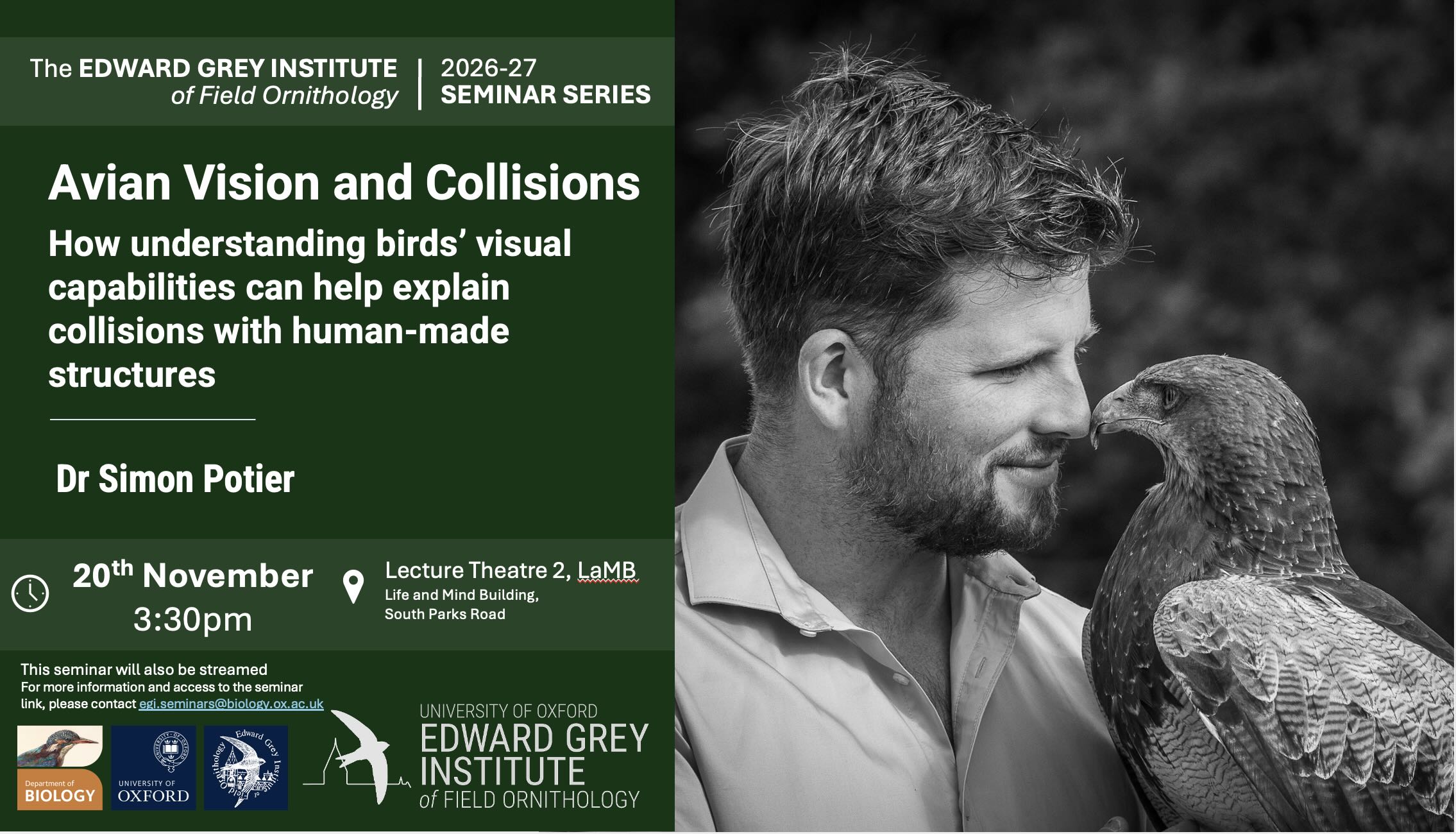
Dr Simon Potier
Lund University